1:59:30. This morning, in London, Sabastian Sawe became the first man in history to run a marathon under two hours in an official race. The 29-year-old Kenyan smashed Kelvin Kiptum's world record (2:00:35, Chicago 2023) by 65 seconds. A massive gap at this level.
And he wasn't alone. Yomif Kejelcha, Ethiopian, finished second in 1:59:41. His very first marathon. Jacob Kiplimo, third, also broke the previous world record in 2:00:28. Three men under the old record. Two under two hours. All on the same day, on the same course.
This is not just a time. It's a turning point for the sport.
What 1:59:30 means concretely
To grasp the feat, you have to put the numbers on the table.
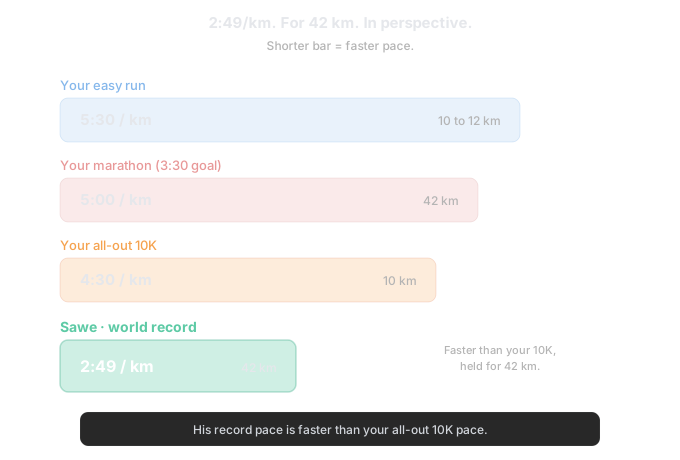
1:59:30 over 42.195 km is 2:49 per kilometre. For 42 km. Without stopping. That's a 10 km split in 28:19. A time most amateurs couldn't hold over a single 10K, let alone for four times the distance.
Pace
2:49 /km
For 42.195 km, without slowing down. About 4:32/mile.
Speed
21.3 km/h
Around the MAS of many amateur runners, held for 2 hours.
10 km split
28:19
Faster than most amateur 10K times, repeated 4 times in a row.
For scale: a recreational runner who runs 45 minutes for the 10K runs at about 4:30/km. Sawe runs almost twice as fast. For four times as long.
Physiologists and statisticians had projected the first official sub-2 marathon around 2035. It happened in 2026. Nine years ahead of schedule.
What happened on the course
The race scenario is as remarkable as the time. The lead group went through the half marathon in 1:00:29. A fast time, but not on world-record pace. Observers on site thought the race would settle around 2:01, as usual.
Then the second half changed everything. Sawe ran his second half in 59:01, a negative split of nearly 1 minute 30. This is exactly the opposite of what we see in most marathons, even at elite level, where runners almost always slow in the second half. It is also what any well-built pace plan recommends at every level.
Sawe's two halves
First half (km 0 to 21.1)
1:00:29
Pace: 2:52/km
Second half (km 21.1 to 42.2)
59:01
Pace: 2:48/km
Negative split of 1:28. The opposite of the usual pattern, where runners crack in the final third.
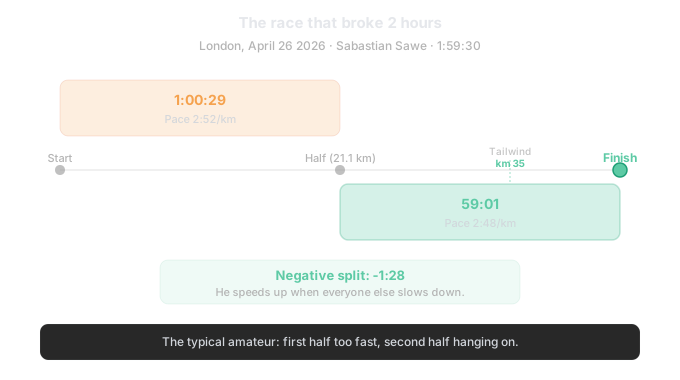
Two factors helped. First: a tailwind from km 35 to km 42, which let him accelerate in the final stretch. Second, and probably the bigger one: Kejelcha was shoulder-to-shoulder with Sawe until the final kilometres. When Kipchoge broke the record in Berlin in 2018, when Kiptum broke it in Chicago in 2023, both were alone over the last 15 kilometres. Pushing alone, with no rival, is infinitely harder than racing two-up. Sawe and Kejelcha pulled each other to a time neither of them would likely have hit on their own.
The shoe question
This is the topic you can't avoid. The progression of marathon records since 2016 lines up exactly with the arrival of super-shoes: carbon-plate shoes with ultra-reactive foams that return energy at every step.
Commentators on site noted it: Sawe and Assefa (women's world record on the same day, 2:15:41) were both wearing shoes from the same manufacturer, likely a prototype. That is not a coincidence.
Could Sawe have run sub-2 without these shoes? Probably not. Do the shoes alone explain the time? Definitely not. Super-shoes have been available to every elite since 2017. Only Sawe and Kejelcha ran sub-2 today, out of dozens of elites with identical kit. Technology opens a door. The athlete walks through it.
The comparison with other sports is interesting. In swimming, the 2010 ban on polyurethane suits set records back several years. In pole vault, every new generation of pole has pushed the limits further. Technology is part of the sport. The question is not whether it helps, but how much.
The women's record: the other feat of the day
The 2026 London Marathon won't go down in history just for Sawe. Tigst Assefa, Ethiopian, broke her own world record in a women-only race in 2:15:41, against 2:15:50 the previous year in London.
The London setup is unusual: the elite women's field starts 30 minutes before the men. No male pacers, no drafting behind taller men. A 100% women-only race. That's a tougher configuration than mixed races where women benefit from the men's draft.
The absolute women's world record still belongs to Ruth Chepngetich, set in a mixed race. But the women-only record is improving fast, and it may say more about the real level of the best marathoners.
What it changes for you (yes, even at 4-hour marathon)
A world record doesn't change your training. But it changes how we think about running. Three lessons that apply at every level.
1. The negative split is possible
Sawe's race strategy, going out "cautiously" (it's all relative) and accelerating in the second half, is exactly what every coach recommends. But most amateurs do the opposite: they go out too fast, blow up at km 30, and finish walking. If the best marathoner in history chose to hold back early and accelerate, that should convince you that pace management matters more than the pace itself.
That's the same logic underlying marathon preparation: you don't run faster by going out harder. You run faster by managing the second half better. And it's exactly what building a segment-by-segment pace plan before the race helps you hold, when start-line adrenaline pushes the other way.
2. Competition pulls you up
Sawe probably wouldn't have run sub-2 alone. It's Kejelcha's presence that pushed him. In your own training, running with people slightly faster than you is an underrated lever. Not to redline every session, but to let yourself be pulled into an effort you wouldn't have chosen on your own.
That's one of the reasons interval sessions in a group make you progress faster than the same sessions solo. And it's also one of the cases for working with a coach: not to tell you how many 400s to run, but to put you in efforts your ego or your caution would never have chosen.
3. The barrier was in the head
Sub-2 was considered "impossible" by many physiologists. Predictive models placed it in 2035. Sawe did it in 2026, and another runner did it 11 seconds later, in his first ever marathon. That's evidence that mental barriers often weigh more than physical ones. The 4-minute mile (Roger Bannister, 1954), sub-10 seconds in the 100m, sub-2 in the marathon: every time, once the barrier falls, others follow immediately. Because the brain finally has proof that it's possible.
The mechanism is well-documented in exercise physiology: it's exactly what central fatigue and the brain's role in pacing describe. Your muscles can often go further than your nervous system allows, and the conviction that a goal is reachable physically changes how your brain regulates effort.
The post-2 era starts now
Sub-2 in official conditions is done. But like the sub-4 mile, the real question is not "who will be first." It's "how long until it becomes normal."
Kipchoge ran 1:59:40 in 2019 in controlled conditions (rotating pacers, chosen course, no competition). Today, Sawe ran 1:59:30 in an open race, against opponents, with no artificial setup. And Kejelcha ran 1:59:41 in his first ever marathon. The door is open.
The next few years will likely see other runners go under 2 hours. Maybe in Berlin (fast course), maybe again in London. The human limit shifts. And every time it shifts, it carries with it a little of the certainty we had that we'd reached the floor.
1:59:30. One man, one April morning, in London. And running will never be the same.
You won't run sub-2. But you can apply the same principles: set a realistic goal from your race times, calibrate your target pace, and build a segment-by-segment pace plan with a negative split before race day. For the taper and night-before fueling, the rest comes down to details no one tells you about until you need them.
Start free
You won't run sub-2. But Kopilo helps you target your best marathon, with a pace plan and a tracking system that adapts to you.