You have been running for 2.5 hours. Your legs feel heavy, your pace is dropping, you cannot push the pace anymore. You assume your muscles are done.
You are wrong. At the end of an ultra, you still have 50% of your maximal muscle force. With 50% of your muscles, you can still run fast. If you are crawling at 5 km/h, it is not because your muscles cannot anymore. It is because your brain decided they should not.
Welcome to the world of central fatigue: a research field that completely redefines what we thought we knew about exhaustion in running. This article draws on the work of Dr Guillaume Millet, one of the most respected exercise physiologists in France, who has been studying fatigue in the lab and in the field (UTMB, 24-hour studies) for over twenty years. What you are about to read changes the way you should prepare a marathon as much as an ultra.
Central vs peripheral fatigue: the distinction that changes everything
When we talk about fatigue in running, we are actually talking about two distinct phenomena that get mixed up.
Peripheral fatigue is the fatigue of the muscles themselves. It comes from the build-up of metabolites that disrupt muscle contraction. That is what happens when you do an all-out 400m, or a session of short intervals: by the end, your muscles are saturated, unable to contract properly because of what has accumulated inside.
Central fatigue is something else. It is the inability of the nervous system to contract your muscles optimally. In other words: your muscles still work, but your brain can no longer send them the signal at full intensity. And it is not a question of motivation. You can want to give everything you have, you simply cannot.
Under "central fatigue", you can also group mental, cognitive, emotional fatigue. All these forms of fatigue that hit the brain before they hit the muscles. And that have a direct impact on your performance.
How fatigue in your brain is measured
The technique has been around since 1952: superimposed electrical stimulation. The principle: you ask an athlete to contract a muscle maximally, then you superimpose an electrical pulse on the nerve that drives the muscle. If the force goes up with the stimulation, it means the brain was not capable of contracting the muscle to its maximum. The muscle still had room, but the neural drive was deficient.
The bigger the gap between the voluntary contraction and the stimulated one, the larger the "voluntary activation deficit". In a healthy subject at rest, this deficit is zero: the brain drives your muscles optimally. But after several hours of running, that is no longer the case at all.
On the UTMB, on 24-hour events, researchers have measured voluntary activation deficits of around 30%. Thirty percent. That means after 20 or 30 hours of effort, your brain only sends about 70% of the maximal signal to your muscles. Even if you try with all your strength. This is part of the reason why the best ultra-trailers drop down to the marathon: the better they manage central fatigue on the road, the further they push it back in the mountains.
What changes by race distance
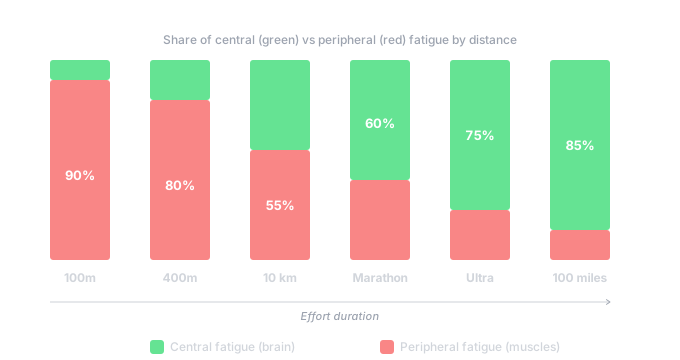
Fatigue is task-dependent. Put differently: the fatigue you feel on a 400m has nothing to do with what you feel on a 100-miler. Roughly:
On short, intense efforts (100m, 400m, 800m, VO2max intervals), fatigue is mostly peripheral. The nervous system still works very well; it is your muscles that saturate from metabolic build-up.
On long efforts (a fast 10K, marathon, ultra-trail), fatigue becomes massively central. And the longer the effort, the more the central share grows, at the expense of the peripheral one. At the end of an ultra, your muscles are often less "destroyed" than you feel. It is your nervous system that has dropped the drive.
Running is special on this point. It generates more central fatigue than other endurance sports of equal duration. Why exactly? Researchers are still digging. But repeated impacts, muscle damage from eccentric contractions (especially on trail descents, which is the whole point of hill work), inflammation: all of it sends signals to the brain that contribute to lowering the neural drive.
The brain's "safety mode": it is not a lack of motivation
Here is the point that changes how you should think about effort. When your brain lowers the drive, it is not that you lack willpower. It is a protection mechanism.
You never die of exhaustion. Never. Even in the worst efforts of an Olympic final, the human body has safeguards that prevent you from going too far. The brain shifts into "safety mode", in a sense: it keeps a reserve, a margin, to prevent the body from putting itself in danger.
This safety reserve is a parameter you can play with. Highly motivated athletes, capable of suffering, reduce this reserve (without ever eliminating it completely). But even the most determined runner never goes to the point of self-destruction. The brain prevents it.
This matters for a simple reason: when you slow down at the end of a race, it is not that you are "mentally weak". Your brain is doing its job as a safeguard. Accepting that means you stop blaming yourself, and start working intelligently on what is actually happening, the same way you learn to read the signals that show your training is working instead of clinging to the numbers on your watch.
The flush model: Guillaume Millet's model of performance
Pure physiology does not explain everything. It describes what happens in the muscles and brain, but it does not explain why two runners with similar physiological profiles can have radically different performances.
Out of that observation came the flush model (or toilet-tank model), an integrative model of performance Guillaume Millet developed and that has been widely picked up in the international scientific community.
The principle is simple. Picture a toilet tank with a cistern that fills up. The water level in the tank represents your perception of effort (or perceived fatigue). When you start a race, ideally, the tank is empty. During the effort, it fills progressively. The fuller it gets, the harder the effort feels. And at some point, you slow down or stop, before it overflows. That ball that prevents the overflow is the safety reserve we just discussed.
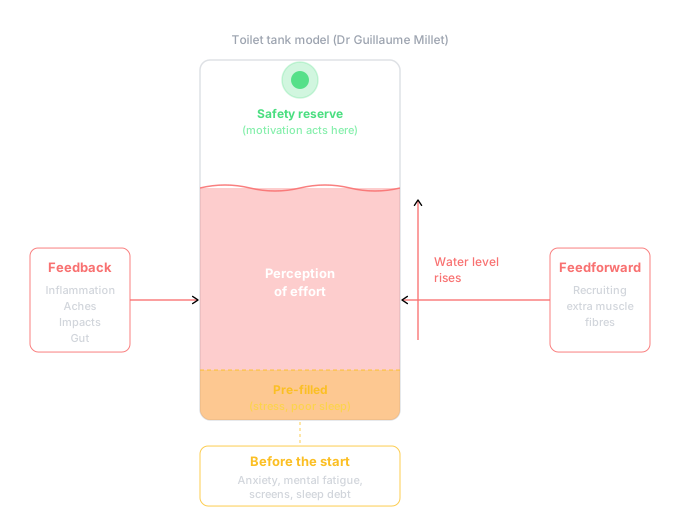
What makes this model powerful is that it integrates several elements pure physiology was ignoring:
The tank is not necessarily empty at the start
If you slept poorly, if you are stressed, if you accumulated mental fatigue during the week, your tank starts pre-filled. You begin the race with a handicap nobody sees, but that you will feel. That is why the taper of the final weeks is as critical as the training that came before.
Motivation acts on the safety reserve
It influences your ability to suffer, but not the speed at which the tank fills. In other words, motivation does not reduce your fatigue: it simply gives you permission to dig further into your reserve.
The water level is subjective
Impossible to measure objectively, because it integrates dozens of parameters: physiological, mental, emotional. What counts is the perception of effort, and that is what determines when you slow down. Hence the value of pacing by feel as much as by heart rate, and more broadly of running by session intent (development, base maintenance, recovery) rather than by precise zones.
The flush model is what distinguishes it from Tim Noakes' "Central Governor", which laid the foundations for the brain's role in performance in the 1990s. The Central Governor talked about the safety reserve, but not about the fact that you can start with a tank that is already half full. And that is often what makes the difference between a good and a bad race.
What training actually improves (and it is not what you think)
If performance depends on perception of effort more than on raw power, that completely changes what training should aim for.
When you train, you are not directly improving your performance. You are improving your ability to limit how fast the perception of effort rises during a race. In other words: for the same level of perceived effort, you can go faster. Or for the same speed, you feel less effort. That is exactly what the logic behind the 80/20 rule captures: lots of low-intensity volume to lower the perceived cost of your target pace, plus a bit of high intensity to raise the ceiling.
This perception rises through two mechanisms:
Feedback: signals coming up from your body to your brain. Nerve fibres picking up acidosis, inflammation, joint pain, impacts, micro-muscle damage, gut discomfort. All of it pushes the water level up. That is also why easy runs that drift too fast cost you twice: you stack the central fatigue from intensity on top of the central fatigue from volume.
Feedforward: when your muscles fatigue and you want to hold the same speed, you have to recruit new muscle fibres to compensate for those that are dropping out. This stronger drive sends a "copy" to the cortex, which logs the effort as harder. That is why a wall sit gets harder and harder while the objective load stays the same.
The fitter you are, the longer you delay the moment when these two mechanisms force you to slow down. That is also one of the angles through which the Norwegian method works: by tightly controlling intensity at threshold, it maximises adaptation while limiting how fast perceived effort climbs.
How to arrive with the tank as empty as possible
If central fatigue starts before the gun even goes off, then the days and weeks leading up to a race become critical. Here is what really matters.
Sleep above all
The night before the race is almost always bad (stress, early wake-up, anxiety). You have little control over it. But you have full control over the previous nights. That is the principle of sleep banking: stockpile sleep over the prior days to repay chronic debt. Naps, 9 to 9.5 hour nights, early bedtimes. Do not be afraid to oversleep. Your resting heart rate on waking is a good barometer: if it climbs during your final taper week, you have not finished repaying.
Limit the hassles
Mental fatigue, anxiety, work conflicts, stressful meetings: all of it pre-fills the tank. If you can, take a week off before the race. Skip the important meetings, the complicated decisions, the avoidable sources of stress. This is not about comfort, it is a direct performance variable.
Manage pre-race anxiety
Some people recharge in solitude, others need company. Introverts can be drained by too much social interaction; extroverts can build anxiety alone in a hotel room. Identify what works for you, and organise yourself accordingly. This is also when the dinner the night before and the breakfast on race day should be non-events, rehearsed in training, so they do not add another layer of worry.
Mental preparation
Underrated, especially on long efforts. Dissociative strategies (thinking about something else, music, mental arithmetic) or associative ones (focusing on your sensations, breathing, stride) actively modulate your perception of effort. When Kipchoge runs, he is not "there". He is elsewhere. His race-day smile is not marketing: it is a perception-modulation strategy. That same mental lever is exactly what played out when Sabastian Sawe broke the sub-2 hour barrier in 2026: a threshold considered physiologically impossible fell nine years before projections, because once the barrier is lifted, the brain authorises the move. Reading personal-development books, training your concentration, learning to manage your emotions during effort: these are performance levers as concrete as physical training. And typically one of the axes where a coach makes a real difference, when the physical alone is not enough.
What this changes for you
Fatigue is not a weakness to fight, it is a signal to understand. When you slow down at the end of a marathon, your muscles still can. It is your brain that decides, and it decides based on signals it has been integrating for days, not just since the start.
That means your race is prepared well before the bib. Your sleep during the week, your stress level, your mental fatigue, your mental preparation: all of it conditions your starting water level. And your starting water level conditions, to a large extent, what you will be capable of on race day. That holds for a marathon as much as for a 10K where you are chasing a time or for a return to running after injury: in every case, the tank fills up before you have even put your shoes on.
Training does not exist to make your muscles stronger (even if that helps). It exists to delay the moment when your brain decides it is too hard. Subtle distinction, but it changes how you think about your approach to running. And it explains why two athletes with the same physiological profile can have completely different performances. In ultra, that is exactly the role of the shock weekend: teaching the brain to stay functional under cumulative fatigue, well before race day. And to track all this week after week without drowning in numbers, the guide on sorting data from feel shows you the 3 blocks worth really tracking.
One concrete and underused lever to delay that moment: strengthening your trunk and upper body. A stronger muscle fatigues later, so the neural drive stays full longer. That is exactly what well-calibrated core work, applied 3 times 5 minutes per week, builds, against the tightening that costs you dearly at km 30.
Turn all this into concrete decisions for race day. Set your training intensities with the heart rate zones calculator, build a realistic goal with the race time predictor, and lay out a segment-by-segment pacing strategy with the pace strategy tool. Good pacing is a tank that fills more slowly.
Your muscles still can. It is your brain that decides. And your brain, you can train.
Start free
Prepare your race with a copilot that accounts for your real fatigue: load, sleep, stress, not just your plan.