RPE. Heart rate. HRV. Ground contact time. Vertical oscillation. Training load. Monotony. Acute to chronic workload ratio. For a few years now, a simple easy run generates dozens of metrics on your watch. And you're told you have to look at all of them to progress.
The reality is simpler, and more nuanced. Tracking your data is useful. But tracking everything, all the time, without knowing why, is the best way to become a slave to your watch and forget why you run. This article sorts out what really helps, what's optional, and what traps you.
Why track: the only good reason
Tracking your performance serves one purpose: making better decisions in your training. If a number doesn't help you decide something (adjusting your volume, changing your intensity, understanding a bad session, validating progress), it's useless. You look at it, you nod, you move on. You just lost 30 seconds.
The rule is simple: only track what leads to an action. If you don't know what to do with a number, don't look at it. That's exactly the logic in how to know if your training is working: the right indicators are not the ones Garmin pushes at you, they're the ones that drive decisions.
The data that actually matters
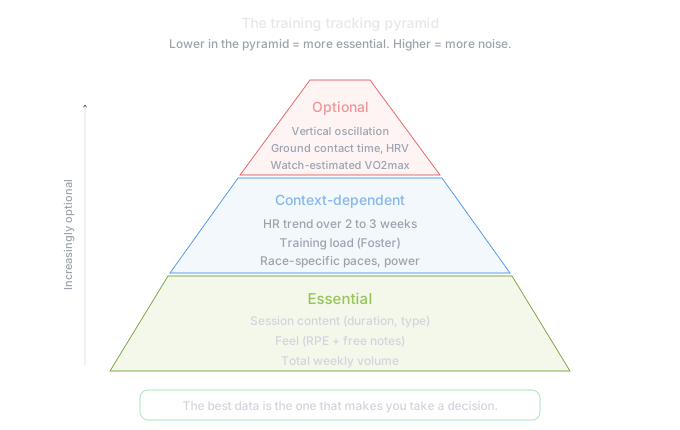
For an amateur endurance runner, three data categories cover 95% of your needs.
Session content
What did you do? For how long? At what pace? How many reps, how much rest between them? That's the foundation. And it's often all you need. Without that, you don't even know if you're progressing or regressing. It's also what lets you, over the long run, compare two blocks: for example seeing that your easy runs at 6:30/km were at 145 bpm three months ago, and at 138 bpm today. There you have information, not just a number.
Feel
How did you feel before, during, after? Physically and mentally? This is probably the most important and most underrated data. An easy run at 5:30/km can be a casual outing one day and a grind the next. The pace doesn't tell you why. The feel does. As we detail in the article on neuromuscular fatigue, perceived effort is not a gimmick: it's the central mechanism that drives your performance.
Total volume
How many kilometres or hours per week, per month? It's the macro indicator that tells you if you're ramping too fast, if you're in a development phase or a recovery phase, and if your body has time to absorb what you're imposing on it. This indicator matters as much when you're trying to go from 2 to 3 sessions a week as when you're preparing a marathon or an ultra-trail.
Everything else (ground contact time, vertical oscillation, running power, morning HRV) is bonus. Useful in some contexts, for some profiles, at some moments. But not essential to progress.
RPE: the most powerful tool (and the simplest)
RPE (Rate of Perceived Exertion) is a 0 to 10 score you give yourself at the end of every session. 0 means you did nothing. 10 means you gave it everything. That's it.
It sounds childish. It isn't.
First, RPE needs no sensor. No watch, no chest strap, no subscription. Just your perception. And that's a major advantage, because it forces you to listen to yourself rather than delegate the assessment to a machine. It's also the method that pairs best with piloting by session intent (development, base maintenance, recovery) rather than by precise zones.
Second, RPE combined with session duration lets you calculate what's called training load (RPE x duration in minutes). From there, algorithms like Foster's allow you to plot monotony curves, strain, and acute-to-chronic load ratio. All indicators that flag overtraining or injury risk well before you feel them.
A "bad" RPE on an isolated session means nothing. High RPE for two weeks straight on sessions that should be easy: that's a concrete warning. Exactly the kind of signal you want to catch before having to come back from injury.
The downside of RPE is that the difference between a 6 and a 7 is fuzzy. A trick that works: instead of dry numbers, use words or images. "Comfortable", "feeling it", "want to go home", "destroyed", "dream session". Feel comes through better in words than numbers, and you'll be more honest with yourself.
Heart rate: useful as a trend, dangerous session by session
Your heart rate is a good indicator of what's happening in your body. The problem is, it's influenced by everything: heat, work stress, digestion, sleep, time of day, caffeine, dehydration. An easy run can show 130 bpm one day and 148 bpm the next, with zero change in your training.
If you read your HR session by session, you're going to draw wrong conclusions. What's interesting is the trend over 2 to 3 weeks. Your average HR slowly drops at the same pace? You're progressing. It stays abnormally high over several sessions even when you're trying to go easy? You're probably overcooked.
That's the same reasoning as in heart rate and the marathon: HR doesn't predict your performance on the day, it tells the story of your fitness over weeks. And that's also why your resting HR dropping month by month is a more meaningful indicator than any single session HR number.
Use heart rate as a macro warning signal, not as a session-level GPS. And if you still want objective bounds to calibrate easy runs and hard sessions, the Karvonen-method HR zones calculator is plenty, as long as you treat it as a frame, not a prison.
The overanalysis trap
An easy run recorded on a modern GPS watch generates dozens of metrics. Ground contact time, vertical oscillation, vertical ratio, cadence, stride length, estimated power, Training Effect, Body Battery, estimated VO2max.
Most amateur runners don't need to look at these. Most coaches don't either. Pick two or three indicators that speak to you, learn to read them properly, and ignore the rest. A data point existing doesn't make it useful.
The clearest example is HRV (heart rate variability). It's a powerful tool to quantify fatigue, but it requires a strict protocol: measure every morning, for five minutes, in the same conditions. If the athlete doesn't follow the protocol, the data is unusable. And for an amateur running 4 times a week, it's a disproportionate constraint relative to the benefit.
The rule: only track what doesn't cost you more effort than it gives you back. And don't trust the morning score your watch hits you with at 6 AM. The Body Battery at 32% because you had a beer the night before should not make you cancel the session your legs are ready for.
When data diverges from feel: that's where it gets interesting
The richest case is when your data says one thing and your feel says the opposite. An easy run where pace and HR are normal, but you feel emptied. Or an interval session where the splits are mediocre, but you felt good.
These divergences are valuable signals, on the condition you logged them. If you only track numbers, you miss the feel. If you only track feel, you miss the numbers. It's in the comparison of both that you really learn to know yourself.
That's why noting your feel, on paper or digitally, matters at least as much as recording the session on a watch. The two complement each other. One without the other is an incomplete picture. This habit becomes critical during a marathon taper, when HR stays high while you cut load: data worries you, feel reassures you, or the other way around.
Paper or digital: the false debate
Are you team journal or team app? Wrong question. Both have different strengths, and pitting them against each other doesn't make sense.
Digital excels at automatic collection (your watch exports everything without you doing anything), long-term aggregation (progress curves, history over months or years), sharing with a coach (they see your session in real time, with HR curves, laps, GPS track), and data processing (Foster curves, load ratios, HR-by-pace trends).
Paper excels at feel. The act of writing by hand forces an introspection that clicking a button doesn't. You think. You put words on what you experienced. You ask yourself questions you wouldn't have asked staring at a dashboard. And the journal creates a physical object, a season memento you can leaf through years later.
There are elite athletes who still use paper journals. There are amateurs who swear by their app. There are people who do both. And there are people who track nothing and run very well.
The ideal tool is the one you'll actually use. A journal abandoned after three weeks is worth nothing. An app you never open after your session isn't either. Pick what fits your personality, your habits, and what motivates you. Not what's trendy.
How Kopilo positions itself
Kopilo was built to do what neither Strava nor Garmin do: aggregate what you did (automatic collection via Strava sync) and what you felt (an RPE, a word, a free note) in the same timeline. Concrete result: training load, monotony, and acute-to-chronic ratio computed for you every week. HR-by-pace trends over 4 to 12 weeks. Weak signals flagged before injury. You stay the pilot, the tool does the aggregation work you'd never do in a spreadsheet.
The point is not to stack numbers. It's to look only at what leads to a decision. And to keep the introspection of a paper journal in an interface where it takes a few seconds to log a feeling.
What data will never replace
All the data in the world doesn't replace knowing yourself. The best runners are not the ones with the cleanest spreadsheets. They're the ones who know, walking out the door, whether it's a day to push or a day to roll, without looking at their watch.
That capacity is built over time, with experience, and above all with the habit of listening to yourself. Paradoxically, it's often by unplugging from data that you learn to listen best. Running without a watch occasionally, writing what you felt before checking the numbers, trusting your breathing instead of a lab-calculated threshold, those are exercises that build athletic intuition. That's also the philosophy of easy aerobic running done right: you learn to recognise a real easy pace, not the one your watch authorises.
Data is a tool. Feel is a skill. The tool can be bought. The skill has to be built.
In practice: where to start
If you track nothing today and want to start, here's a minimal and effective starting point.
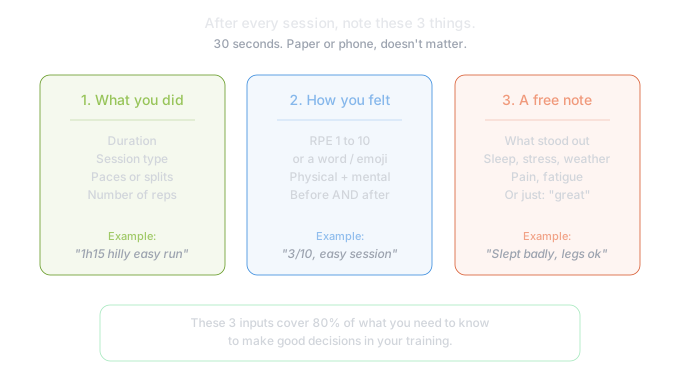
1. Note three things after every session
What you did (duration, content). How you felt (a word, an emoji, an RPE 1 to 10). An optional free note (slept badly, work stress, heavy legs, dream session). 30 seconds. Paper or phone, doesn't matter.
2. Look at your week, not your session
Once a week, look at your total volume and your RPEs. If everything is at 7 or 8 out of 10 even though you only ran easy, something's off. Accumulated fatigue, external stress, volume too high. If everything is at 3 or 4 and you're progressing, you're on the right track.
3. Calibrate your objective references once, not every session
A MAS estimate once a year, Karvonen HR zones updated when your resting HR really shifts, a race time prediction before a goal race. That's it. No need to recalculate your MAS every month.
You can refine later if you feel the need. But these three inputs (content, feel, free note) cover 80% of what you need to know to make good training decisions. And it's the foundation Kopilo uses to automatically surface Foster load, monotony, and fitness trends without you ever opening a spreadsheet.
What to take away
1. Useful data is data that drives a decision
If a number doesn't make you adjust something (volume, intensity, recovery, sleep), don't look at it. Everything else is noise.
2. Three blocks cover 95% of needs
Session content, feel, total volume. RPE is your most powerful tool and it costs nothing. It feeds Foster training load, which weighs more than an estimated VO2max.
3. Trend beats single-day score
HR dropping at the same pace over 2 to 3 weeks: you're progressing. High RPE on sessions that should be easy for two weeks: you're cooking yourself. Look at the curves, not the morning score.
The best data is the one that drives a decision. Everything else is noise. Data is a tool, feel is a skill. A good tracking system doesn't replace listening, it builds it.
Start free
Keep the introspection of a paper journal, with the power of automatic collection. Kopilo aggregates your sessions and your feel into a timeline that surfaces the trends that matter.