Zone 2. Lactate threshold. Polarised. 80/20. RPE. Over the past three or four years, terms borrowed from elite sport have flooded social media and everyone's training plans. You'd think running a half marathon now requires a lab and a spreadsheet.
Except the pros don't train the way Instagram tells the story. And most of what you think is necessary to progress is, at best, useless. At worst, counterproductive.
Zone 2 is nothing new
Social media "discovered" Zone 2 a few years ago. But in endurance sports, low intensity has been the foundation for 30 years. Ask any former endurance athlete: the first thing they were taught at 13 or 14 entering a high-performance structure was to train slow. Not because it's trendy. Because it works.
Low intensity activates the parasympathetic nervous system, the one that calms. In a sport like Nordic combined, where ski jumping and weight training tax the nervous system heavily, easy aerobic sessions were used to rebalance. Without them, the brain stays in "stress" mode permanently, sleep degrades, and overtraining hits quickly.
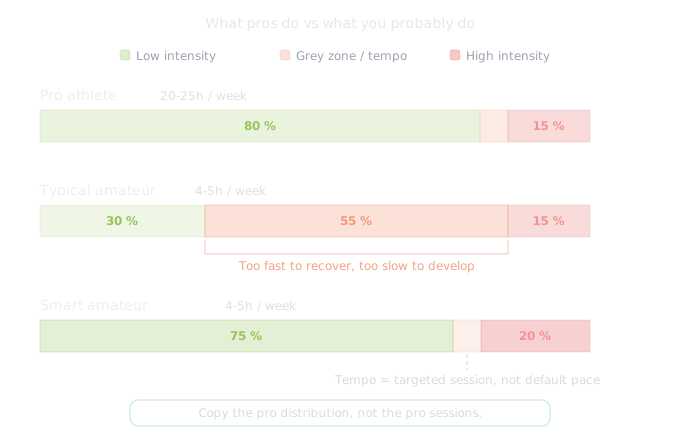
For an amateur with a job, kids, daily stress, the logic is exactly the same. Your nervous system is already taxed all day. If you push hard on every session on top of that, you never recover. Result: you stagnate, you get injured, or you burn out. That's also why many runners have easy aerobic runs that are too fast without realising it, and end up plateauing.
A former Olympian in endurance sport puts it simply: "If you go all out all the time, you don't sleep at night. Your brain is wide-open all the time and you burn yourself out. Easy aerobic does you a world of good."
Thresholds: useful to understand, useless to measure (for an amateur)
You hear a lot about lactate thresholds, lab tests, precise zones not to be exceeded. Many strength coaches with elite backgrounds are categorical: for an amateur athlete, a lab test makes no sense.
Not because the science is bad. Because a threshold is a snapshot of the day. It varies with your fatigue, your glycogen stores, the time of day, your stress, your digestion. Olympic athletes have lived this directly: their threshold values came back to roughly the same numbers at every test, whether they were in great shape or terrible shape. And yet the sensations had nothing to do with each other.
In practice, there are two thresholds to understand (not to measure to the beat):
First threshold
Effort starts to ramp up, you become slightly out of breath. You can still talk, but you feel something has changed. It's the upper limit of low intensity.
Second threshold
It really ramps up. You can only get a few words out. A highly trained athlete can hold this intensity for about 40 minutes. An amateur, more like 20 to 30 minutes.
All you need to know to train correctly: am I out of breath? If yes, you're above your first threshold. Can I still talk in full sentences? If no, you're probably above your second threshold.
Coaches with elite backgrounds train high-level amateurs (sub-2:30 marathon, sub-1:10 half) with this level of precision. And they progress. No need for a lactate meter in the woods. If you still want objective markers to calibrate easy runs and hard sessions, the Karvonen-method heart rate zones calculator is plenty.
Three session intents, not seven zones
Here's what simplifies everything. Some coaches with elite backgrounds don't think in zones, they think in session intents. There are only three.
Red
1. Development
The session that actively builds fitness. Can be high intensity (intervals, threshold, vVO2max). Can also be a long run. Yes, a 3-hour long run at low cardiac intensity is a form of development, because you can't repeat it daily. It's a stress on the body, even if your heart rate stays low.
Blue
2. Base maintenance
Moderate sessions that keep the engine ticking. A one-hour to one-hour-fifteen easy run. Not intense enough to develop, not easy enough to recover. It's the foundation of endurance training.
Green
3. Recovery
Easy sessions, 20 to 30 minutes, where you finish less tired than you started. Their purpose: bring the nervous system down, absorb the previous work, and add a running frequency to the week without generating fatigue. 20-minute easy runs work very well for amateurs because they add running volume without extra load. It's also the right lever when you want to go from 2 to 3 sessions a week without breaking your recovery.
To visualise this, a colour code is enough: green (easy), blue (moderate, long but moderate), red (hard). See the colour, get the intent, no need to know your threshold to the beat.

The "forbidden zone" trap
You've probably heard that you absolutely shouldn't train between the two thresholds, that famous "grey zone" or "Zone 3" in a 5-zone model. Too fast to develop low-intensity adaptations, too slow to develop high-intensity adaptations. The worst of both worlds.
That's true. And it's false.
It's true if your low intensity is systematically done in this zone. There you're too taxing, you don't recover, and long term it doesn't hold up.
But it's false to say this zone is forbidden. Many experienced coaches call this tempo, and they love it for their amateurs. Why? Because it's often race pace. If you're preparing a 50K trail, a half marathon, or even a marathon, you'll spend a big chunk of the race in this zone. Never going there in training means never training your race pace. That's also why the Norwegian method places threshold work at the heart of training, and why the 80/20 rule (Fitzgerald version) gets it wrong when it labels this zone as "to avoid".
The mistake is to confuse "I'm training in this zone to develop" and "I'm training in this zone because it's the fun pace and I can't go any slower". Tempo is a hard session, it counts in your development quota, not in your low intensity.
That's exactly what many athletes who shift from elite to amateur training experience. In elite sport, they almost never went into this zone: it was either low intensity or very high intensity. Switching to trail, you can't avoid it. And at first, they systematically go too fast in this zone, which burns them out.
The problem isn't the zone. It's data slavery.
You probably know this runner. They're preparing a half. They read that you have to stay in Zone 2 on easy runs. Except outside, the route isn't flat. As soon as they hit a hill, their heart rate goes 5 to 6 beats above their "zone". So they walk. Or worse: they run on a treadmill to never exceed their threshold.
It's absurd, but it's increasingly common. Your heart rate will go up on a hill. That's normal. It will come back down after. The intent of your session is to go easy for an hour. Not to be within plus or minus 2 beats of your threshold for 60 minutes. If you exceed your zone for 5 minutes on a hill, nothing is ruined. What ruins your progression is never running outside, never confronting real terrain, turning every session into a dashboard management exercise. In fact, working hills in training is one of the best things you can do: the hill training guide covers it all.
By insisting on respecting "Zone 2", people become slaves to their watch. They no longer run, they manage numbers. And paradoxically, it stops them progressing, because they never learn to listen to their body.
The body knows. When you're out of breath, you feel it. When you're going too fast for the planned session, you feel it too, if you're used to listening. The problem is that many runners have never trained themselves to listen, because they've always delegated that to their watch. Perceived effort isn't a gimmick: it's a neurophysiological signal that drives your performance and is worth far more than a number at any given moment.
Heart rate: useful as a trend, not at a single moment
Data isn't useless. But data taken session by session is worth nothing. What's worth something is the trend over 2 to 3 weeks.
Your heart rate at any given moment is influenced by: the day's fatigue, work stress, digestion, heat, altitude, time of session, sleep quality. An "easy" run can show 130 bpm one day and 150 bpm the next, with nothing changed in your training.
On the other hand, if over 3 weeks you observe your heart rate slowly dropping at the same pace, you know you're progressing. If it stays abnormally high over several sessions even when you're trying to go easy, you know you're probably too tired. That's exactly the reasoning in how to know if your training is working and in heart rate and the marathon: the trend beats the isolated number.
The rule: use heart rate as a global warning signal, not as a session-by-session GPS. And use RPE (perceived difficulty 0 to 10) as your daily piloting tool. The fact that your resting HR drops over the weeks is another trend, more meaningful than any single easy run. To go further on what's actually worth tracking day to day, the data vs feel guide details the 3 blocks that cover 95% of your needs.
Polarised vs pyramidal: "an Instagram debate"
You may have seen heated discussions on the "polarised" model (lots of low intensity and a bit of very high intensity, nothing in between) versus the "pyramidal" model (lots of low intensity, some intermediate, very little high intensity). The kind of topic that generates 500 comments and zero consensus.
Field coaches answer bluntly: "It's an Instagram debate. In real life, what matters is: what race are you preparing? What do you need to develop? The 80/20 rule holds in number of sessions, but what you put in the 20% depends on your goal, not on a theoretical model."
The conclusion is simple: the ideal distribution doesn't exist in the abstract. It depends on your goal race, your profile, your time of year, and what you feel like doing. Hunting for THE perfect model is wasted time you'd be better off spending running. To dig into the 80/20 rule and its limits, read why the 80/20 rule is shaky.
What pros actually do (that nobody tells you)
A former Olympian in Nordic endurance sport trained 20 to 25 hours a week at the peak of their career. Of those hours, 10 to 15 hours were pure aerobic: slow, easy, at a rhythm where their physical preparator scolded them for going too fast when they ran together. The Norwegians, the world's best in Nordic endurance sports, train even more slowly.
In cross-country skiing training, the athletes go so slow that the technical staff sometimes caught up to Norwegian skiers mid-session. And those same Norwegians, in competition, would smash them.
The message: the world's best spend the majority of their time at an intensity most amateurs would consider "too easy". And when it's time to hurt themselves, in competition or on key sessions, they have a capacity to push to the end that few have.
One doesn't prevent the other. On the contrary: it's because they train slow 80% of the time that they can lay it all on the line the other 20% without destroying themselves. That's also the lesson ultra-trailers who race the marathon apply instinctively, and the foundation of a weekend-shock ultra preparation.
Consistency beats intensity
This is the through-line of the whole conversation. You'll progress more by training 52 weeks a year than by training 32 weeks because you were burned out for 20.
The reasoning often heard from amateurs: "I only have 3 to 4 sessions a week, so I'll go all out 2 to 3 times to compensate." The logic holds in theory, but it's not viable long term. Because intensity repeated without a base of volume produces fatigue, injuries, and breaks. And breaks kill progression. If you're coming back from an injury, our guide on returning to running without getting injured gives you a framework for ramping back up without crashing again.
The approach that works: be conservative. Even with high-level amateurs (sub-2:30 marathoners), experienced coaches keep a system where the majority of sessions are comfortable. Intensity is dosed, targeted, and always serves a precise objective. Never systematic.
It's counterintuitive for an amateur with little time. But the question isn't "how many hard sessions can I cram in?". It's "how many weeks in a row can I train without breaking down?". The second question matters more than the first.
Enjoyment isn't a bonus
Many former elite athletes, once they become amateurs, no longer run for times. They run with friends, throw on a backpack, have fun, discover trails. Sometimes they tease each other on an easy run. Sometimes they go alone in the mountains for two hours easy, and call that the best session of the week.
That's not casualness. It's strategy. If you do sport and you're not enjoying it, why are you doing it? Enjoyment isn't something you tack on after a session well done. It's the engine that gets you out 52 weeks a year, and therefore the engine of your progression.
Advice for people who always go full gas: accept that some days, you want to push. Do it. But not every session. And when you go easy, find enjoyment elsewhere than in speed: the landscape, the meander, the podcast in your ears, the three phone calls during the run. Training doesn't need to be hard to be useful.
What to take away
Stop looking for the perfect plan. Stop trying to know your thresholds to the beat. Stop comparing your sessions on Strava.
If you take three things from this article:
1. Low intensity is the foundation
The world's best spend the majority of their time there, and you should too. No need for a lactate meter, a Karvonen zones calculator and the talk test do the job.
2. Consistency beats intensity
Better to train at 80% for 52 weeks than to push 100% for 8 weeks followed by 3 months off. The training that pays is the one you sustain over time, not the one that explodes you 3 times a month.
3. Listen to your body before your watch
Feel is a more reliable and durable tool than any single data point. Data is there to confirm a trend, not to drive every step.
The best advice anyone can give: "Make sense of what you do. Not because someone louder than the others told you that if you didn't do this, you were wrong. In training, there really is no single truth."
Pros don't train the way Instagram tells the story. And you don't need to either. A clear intent per session, a simple colour code, the trend rather than the day's number, and a lot of patience. That's training like a pro. And it requires neither a lab nor a spreadsheet.
Start free
Pilot your intensities by intent, not by data obsession. Kopilo handles the trend reading for you.