You signed up for UTMB, for a 100-miler, for a major mountain ultra. You're motivated. You have a training plan. Except between work, family, and life in general, you barely scrape together 7 to 8 hours of training per week. So the question that keeps coming up in every running group: how do you prepare for an ultra when you can't train like a pro?
The answer is in two words: shock weekend. It's a method developed by Dr Guillaume Millet, exercise physiologist and former top-6 finisher at UTMB, specifically built for non-elite runners. Today it's used by most amateur trail runners, often without them knowing where it comes from or how to do it properly.
This article explains the concept, where it comes from, what a real shock weekend looks like, and who it actually works for.
The problem it solves: specificity you can't train any other way
When you run an ultra-trail, you're going to walk. A lot. Not because you're bad, but because it's the most efficient mode of locomotion on certain slopes (above 22% grade, walking is as fast as running, sometimes faster). You're going to run at very slow speeds on climbs: 8 to 12 km/h (5 to 7.5 mph). You're going to use trekking poles. You're going to be on your feet for 15, 20, 30 hours or more.
None of these muscular operating modes is reproduced in a classic training week. Your vVO2max sessions, your easy runs, even your 3-hour long runs don't load your muscles at the same lengths, the same speeds, the same contraction modes as an ultra. In other words: you can be in great physiological shape (good vVO2max, good threshold, solid endurance) and collapse at km 60 because your body has never seen what it's experiencing.
Guillaume Millet learned this the hard way on his first UTMB. He arrived in good general shape, but had never specifically worked long descents or the hike-run mode. The result: a brutal failure. The shock weekend idea was born from that failure, inspired by the "shock micro-cycles" theorised by Russian coach Matveyev in a completely different context. The same logic also explains why your quads fail before your cardio at the back end of an ultra: the body hasn't learned to hold up in that register.
The principle: regroup the hours, don't add them
Here's the point most people miss: a shock weekend is not added training. It's redistribution.
If you train 8 hours a week, you keep training 8 hours a week. The difference is that on certain weeks, you concentrate those hours into 2 or 3 days. Before the shock weekend, you train less. After, you recover. Total weekly volume is unchanged; only the distribution shifts. It's the exact opposite of the linear logic of a classic plan, where sessions stack without modulation. The Norwegian method and its load micro-cycles share the same intuition: what matters is the smart distribution of stress.
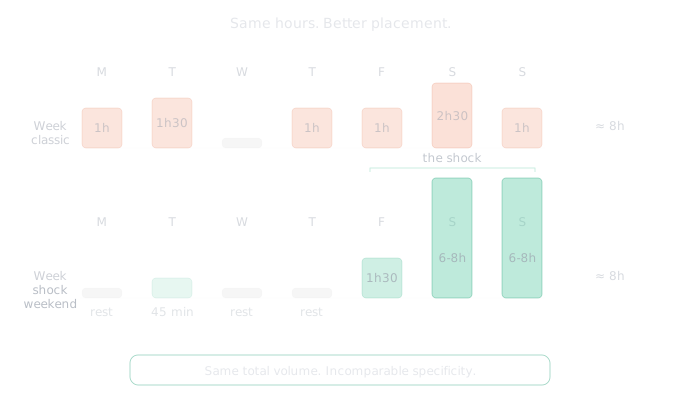
Why does it work? Because an ultra is more than one day on your legs. Even if you finish in 15 hours, that's 15 hours of cumulative impacts, micro-tears that pile up, and fatigue that climbs progressively. No 2 or 3-hour session reproduces that. Only a long effort, repeated over several consecutive days, puts you in real conditions, without breaking your body the way a race would.
It also assumes you have the base that lets you take the shock. If you're still moving from 2 to 3 sessions a week, the shock weekend isn't for you. It's aimed at runners already settled into a stable training routine.
Who it's for: the 95% who aren't elites
Guillaume Millet is clear: elite runners (Kilian Jornet, François D'Haene who can train 5 hours a day, 6 days a week) don't need a shock weekend. They're so loaded in daily volume that specificity gets worked into their normal week.
But once you go down a notch (good-level runners but not top 5, motivated amateurs, mid-pack runners), the shock weekend becomes near-essential. For the 95% of trail runners with a job, family, real constraints, it's the only way to introduce real specificity into preparation.
It's a pragmatic method, built for people who aren't pros. And that's probably why it's been picked up so widely: it answers a real problem with a real action framework. Same logic of stimulus transfer found in ultra-trailers who race the marathon in their preparation: hunting for stimuli absent from the daily routine.
What a typical shock weekend looks like
Guillaume Millet describes what he did himself in his UTMB preparation. It's a base, not a rule: you can adapt, but the skeleton stays the same.
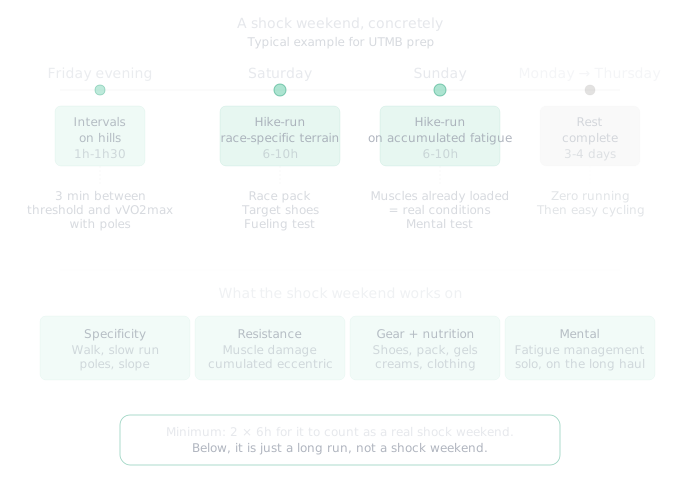
Friday evening. Hill intervals
A short but intense session, 3 minutes / 2 minutes at an intensity between threshold and vVO2max (not full vVO2max), on hills, with poles. The goal isn't to fry yourself, it's to pre-fatigue the system before the two big days. To calibrate intensity, lean on your usual hill sessions and your vVO2max.
Saturday. Long hike-run
Early start, 6 to 10 hours of effort, on terrain close to your goal race. Run-walk alternation, with poles, with the pack you'll use on race day, with the same shoes, the same fueling. Sometimes one outing in the morning and another in the evening, to break it up. Intensity stays low: this is base work, not quality. If you're not sure of your target zone, your easy aerobic running is probably too fast.
Sunday. Same again
6 to 10 hours again, same principle. This is where your body actually learns something. Your muscles are already loaded from yesterday, you have to manage the accumulated fatigue, your economy strategies set themselves up automatically. It's exactly what you'll experience in the race, without the stress of competition.
Minimum duration and variants
At least 2 x 6 hours over the two days. Below that, it's not a shock weekend, it's just a big long run. Above, you can extend to 2 x 10 hours if you're used to it and your goal race justifies it.
Variant: some runners do a 3-day shock weekend, with a lighter Sunday. Others start as early as Thursday. The day doesn't matter: what matters is the cumulative duration and the repetition over several consecutive days.
Benefits beyond physical training
When Guillaume Millet started using the shock weekend, his goal was mainly resistance to muscle damage and movement specificity (walking, slow running, poles). Over time, he realised the concept brought much more.
Test your gear. Do your shoes hold up over 15 hours of descents? Does your pack hurt your shoulders after 8 hours? Your jacket, your headlamp, your gloves: all of it gets tested in a shock weekend. Not in a 3-hour long run.
Test your fueling. Can you eat 80 grams of carbs per hour for 10 hours without GI distress? How does your stomach react to your gel/bar/solid-food mix after 8 hours of effort? It's the only situation where you can really know before race day. Same logic as the night-before marathon meal: nothing gets tested for the first time on race day.
Test your mental strategies. What you do in your head when you're alone on a trail at hour 9 of a race, tired, with 5 hours still ahead: that doesn't simulate. The shock weekend is the only place where you can train to manage that moment. It's also where central fatigue gets trained: not with an intense session, but by learning to walk through it.
Test anti-chafing creams, foot creams, the shirt that doesn't itch after 12 hours of sweat. A thousand details that, badly tuned, can ruin a race. And that you can't test anywhere else.
Test upper-body durability. Pushing on poles for 10 hours quickly reveals a weak trunk or under-trained traps. That's where core training built into the week pays back: less shoulder tightening, poles that stay an economy tool instead of dead weight.
A shock weekend is a dress rehearsal. Not just a workout.
Pick the right terrain
Since you're blocking 2 or 3 days for it, it's worth driving somewhere to train on terrain that resembles your goal race. Preparing UTMB? Go to the Alps. Targeting a major Réunion ultra? Find technical terrain with a lot of elevation. The specificity gain (slope type, descent technique, ground type) easily justifies the trip.
It's not always possible, of course. But if you live in flatlands and you're preparing a mountain ultra, a shock weekend done in the flats will have far less value than one done in real terrain. It's a trade-off you have to make.
Risks and how to avoid them
A shock weekend is intense stress on the body. And intense stress means injury risk if you're not careful.
The rule: shock the muscles, don't destroy the joints. DOMS in the quads after a shock weekend is normal. It's actually a sign it worked. But if pain starts in a knee, an ankle, a tendon, you stop. Finishing your shock weekend at all costs while ignoring joint pain is the best way to get injured for several months.
The signal to listen to: muscle burn, OK. Joint sting, you go home. Ultra-trail injuries are almost always joints failing, rarely muscles. And if you come back with pain that doesn't pass within 48 hours, the post-injury return plan will be more useful than stubbornness.
Another precaution: don't stack two shock weekends close together. Guillaume Millet recommends one in a preparation cycle, not every two weeks. Adaptations need time to settle; and above all, the body needs time to recover.
After: recovery
Here's a truth often forgotten: a well-done shock weekend destroys you. Not in a damaging sense, but in the sense that for 3 to 4 days afterwards, you do nothing. Zero. No running, no training cycling, no hard hiking. Complete rest.
Then very gradual return, ideally through low-impact sports (cycling, swimming) before lacing up running shoes again. That's the price for adaptations to settle. If you go running on Monday because you "feel good", you waste the entire benefit of the weekend, and you raise your injury risk. Same logic as the marathon taper: let the body consolidate instead of continuing to hammer.
The marathon variant: Renato Canova's "special bloc"
For the curious wondering whether the concept exists elsewhere: yes, in different forms. Italian coach Renato Canova, marathon specialist, developed the special bloc: two big marathon sessions in the same day, with the goal of simulating the last 10 to 12 km of the race.
Canova even went as far as asking his runners to cut carbs between the two sessions, to amplify fatigue. Guillaume Millet tried it once. Verdict: "Never did it again. It created a fatigue I couldn't really shake afterwards." For an amateur runner, it's a useless risk.
The logic is close to the shock weekend (overload to create specific adaptations), but the method is more extreme and more specialised. For the ultra, the Millet formula stays better suited: 2 to 3 days, no carb restriction, priority to movement specificity. That's also why marathon preparation and ultra preparation diverge sharply from 4 weeks before the goal.
What to take away
The shock weekend is not a miracle session. It's a specificity tool, designed for runners who don't have the daily volume of pros. It turns 2 to 3 days per cycle into a dress rehearsal of your goal race: gear, fueling, mental, specific muscles, all of it.
For an amateur trail runner preparing an ultra, it's probably the highest-yield element of the entire preparation. More valuable than an extra interval session. More valuable than a more complicated plan. Because it works exactly what nobody else works: the combination of duration + specificity + back-to-back.
Once or twice in a preparation cycle, placed 4 to 6 weeks before the goal race. That's plenty. And it's probably what makes the difference between finishing your ultra and collapsing at km 80. To pin down the exact week, a race time predictor can help you estimate your real finishing time and therefore the scale of shock weekend you actually need.
For the 95% of us who aren't Kilian. The pragmatic method to prep an ultra with a real life going on alongside.
Start free
Kopilo builds your ultra plan factoring in your available volume, your terrain, and your calendar. Your shock weekend gets placed at the right moment, not by gut feel.