You hold a plank after every easy run. 30 seconds, a minute, sometimes more. You tell yourself it's good for your running, that it'll make you faster, that it's the foundation of strength work.
What if you were missing the point?
Core training is neither useless nor magic. It's a tool, and like any tool, its impact depends on how you use it, when you use it, and what you expect from it. This article unpacks: why the upper body matters when you run, what core training actually works on, and how to stop wasting time on poorly calibrated exercises.
Why the upper body matters when you run
You don't run on your hands. So instinctively, we assume it all happens in the legs. But there's a simple principle: you're never stronger than your weakest link.
If your upper body is weak, your overall performance is dragged down. And that plays out at several levels.
Arms drive the running rhythm
Track coaches know it: when they want a runner to pick up cadence, they don't say "drive the legs faster." They say "drive the arms faster." The feet follow mechanically. Try it on your next interval session: increase your arm speed and you accelerate without thinking.
Arms reduce the load of gravity
When you run, the arm action reduces the vertical load on your whole body. The more efficient the arm swing, the less your legs absorb. Simple as that. And it's exactly that vertical load, repeated over more than three hours, that breaks your anti-gravity muscles at km 30 of a marathon.
The core transmits the forces
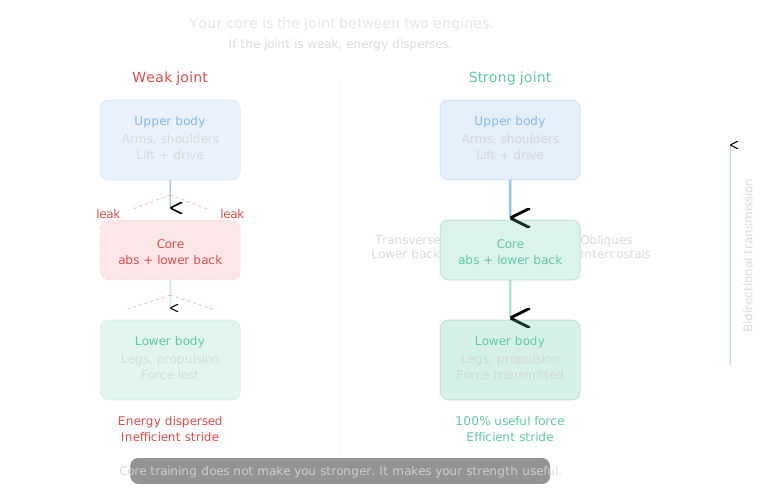
The core (abs and lower back) is the joint between the upper and lower body. If that joint is weak, the force generated by your legs disperses instead of transmitting forward. And the lift created by your arms doesn't transmit downward. You run with energy leaks everywhere.
For trail runners using poles, it's even more obvious. Pushing on poles for 20 hours demands arm, shoulder, and trunk strength you don't develop just by running. If your arms tire too quickly, the poles become dead weight rather than an economy tool, and that's a central concern when preparing an ultra with limited weekly hours.
Upper body muscles that matter in running
You could say "all of them" because the body works as a system. But some groups are more critical than others.
The transverse abdominis
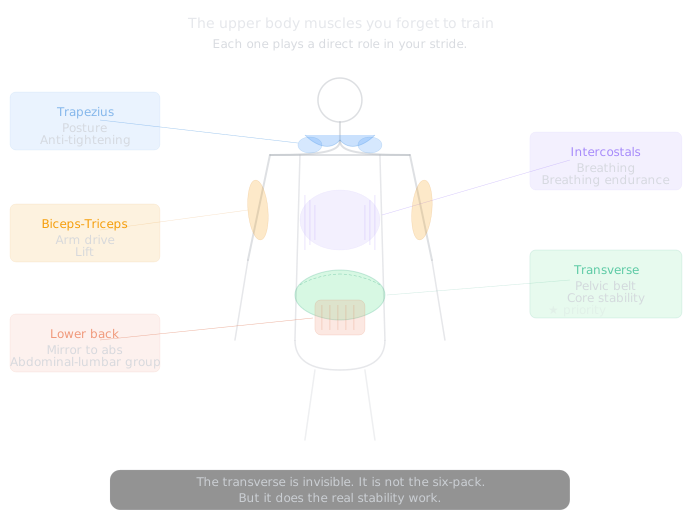
The priority muscle for core training. Picture a kind of belt wrapping around your pelvis. It's what holds the whole thing stable when you run. It's not visible (it's not the "six-pack"), but it does the real work.
Lower back muscles
They mirror the abs. The transverse links the two. Together, they form the abdominal-lumbar group: the heart of stability.
Intercostal muscles
We never think about them, but these are the muscles that drive breathing. They tire too, especially over long efforts. Weakness here can limit your breathing capacity at the back end of a race.
Biceps and triceps
They drive the arm swing, the same swing that creates the drive and the lift we just talked about.
Trapezius
They contribute directly to running posture. When you tire, your shoulders ride up, you tighten, you lose stride amplitude. Stronger traps push that moment further back.
Tightening: the real enemy of running economy
Tightening is the early stage of cramping. The muscle is in constant contraction, and contraction means energy expenditure. A muscle that doesn't relax is a muscle that burns energy for nothing.
You've felt it: from km 30 of a marathon, your shoulders ride up, your fists clench, your face tightens. Your motion degrades, your posture closes in, every stride costs a little more energy. On an ultra, it can become a full contracture: a fatigue-induced posture that locks back and neck muscles in permanent tension for hours.
Upper body strengthening works against tightening on two levers. First, neuromuscular control: strength work teaches your muscles to relax, to send the "don't contract" signal, which is a learned skill. Second, fatigue resistance: a stronger muscle tires later. And if it tires later, the tightening arrives later, or maybe not at all.
That's the same logic that explains why neuromuscular fatigue makes your brain slow you down before your muscles. The longer you push back the moment when fatigue signals become critical, the longer you hold target pace.
Crunches: not useless, but not optimal
The crunch, that classic exercise where you lift your torso from a lying position, mostly works the rectus abdominis (the "six-pack") and the obliques if you add lateral variations. It's the most visible muscle, but not the most useful for running.
For a runner, crunches are limited in value. The rectus abdominis doesn't play a central role in running stability or in force transmission. If you enjoy them, it's not a disaster, but it's not optimal either.
Important note for women runners. The crunch creates downward pressure on the pelvic floor. If you still want to do them, squeeze a Swiss ball (or any wide object) between your knees to engage the pelvic floor and offset that pressure. And never anchor your feet under a radiator or piece of furniture: it pulls on the psoas and can stress the hip area.
Core training: creating stability within instability
That's the real role of core training. Running isn't a linear movement. It's a chain of unstable foot strikes: at every step, you're momentarily off-balance, and your body has to stabilise the whole system so force transmits efficiently.
Core training builds exactly that capacity: maintaining trunk stability while the rest of the body moves. And that's why the static plank has limits.
Holding a plank for 1:30 proves you have a minimum of trunk strength. Holding a plank for 5 minutes proves you're patient. It doesn't make you a better runner. The world record is over 9 hours, and the holder is not the world's best runner.
Once you've mastered the classic planks (front, left side, right side) at 1 minute to 1:30 fairly comfortably, move on. Add variations. That's where the real work begins.
The variations that make a difference
Three directions for evolving your core work, in logical order of progression.
1. Add instability to the plank
Lift a leg. Extend opposite arm and opposite leg (the "Spiderman" position). Place your elbows on a cushion or a Swiss ball. Stand on one foot. The idea: force your trunk to stabilise a moving system, exactly like in running.
2. Move to dynamic exercises
The most relevant exercise: hold a bar (or a broomstick) overhead with arms extended, and do high-knee marches in place. Pause for a moment when one foot is in the air. You're forced to brace the core to stay balanced, and you simultaneously work proprioception, balance, and lumbo-pelvic stability. Infinitely closer to running motion than a static plank.
3. Add an unstable load
The most advanced variation: replace the bar with a water bag (a sandbag-style bag filled with water). The water shifts during the movement, pulling you side to side and forcing deeper stabilisation work. Naturally progressive: start with the bar, then move to the water bag once you've mastered it.
Same logic as in running: once the body adapts to a stimulus, you have to change it to keep progressing. Doing the same 1-minute plank for 3 years is like running the same 45-minute easy run with no modification: the body has no reason left to adapt.
When and how much: the method that actually sticks
Best moment
After an easy run. Not after a hard interval session where you're wiped. Not solo in the evening on the couch (you won't do it). After a calm jog, at home, while muscles are still warm.
Best frequency
3 times a week beats 1 time a week, every time. Three sessions of 5 minutes always beat one session of 15 minutes. It's frequency that builds adaptation, not the one-off dose.
Duration
5 to 10 minutes per session, no more. A set of small exercises, not 10 minutes of front plank. 3 or 4 exercises of 30 seconds to 1 minute, 2 or 3 rounds, done.
If you do 3 easy runs a week and you tack on 5 minutes of core after each one, you have a solid trunk-strength programme without adding a single session to your schedule. It's the kind of detail you spot when you step back and look at what really works in a training week.
Core training during a build, and during the taper
During marathon preparation, core training is a direct investment. It strengthens the joint that has to transmit force for 3 to 4 hours, and pushes back the tightening that inevitably arrives in the late stages. It's also an excellent complement when you come back from injury: while your weekly mileage ramps slowly, core training lets you keep building without adding impact.
During the 3-week taper, you're not chasing progression any more. You're maintaining. Core training becomes even more useful: it engages the muscles, keeps the movement pattern, and costs little in overall fatigue. You drop running volume, you keep quality, and you slot in your 3 x 5 minutes of core after your easy runs. No more.
Core training for trail runners: even more central
In trail running, the upper body is no longer a bonus. It's a central piece. Technical descents demand trunk stability to absorb landings and read the terrain without losing balance. Long climbs with poles, as mentioned earlier, directly load arms, shoulders, and the abdominal-lumbar group. Neglected core training costs you twice in trail: through premature upper-body fatigue, and through loss of precision in your motion.
That's one of the reasons the best trail runners who switch to road don't suffer in the transition: they arrive with a trunk that's already solid, capable of holding hours of effort without breaking down on posture.
What to take away
Core training is not overrated, and it's not the magic solution either. It's one of the elements of stride efficiency: through force transmission between upper and lower body, through arm-driven load reduction, and through stabilisation in a movement that is, by nature, unstable.
Classic crunches are not optimal for runners. The transverse abdominis, lower back, and trapezius matter more than the rectus abdominis. The static plank plateaus past 1:30: shift to dynamic variations. And the most important point: 3 sessions of 5 minutes a week beat one big Sunday session by miles.
Core training is a whole-body practice. Not just "abs." And it's a pillar of running economy that too many runners neglect, or practise the wrong way.
Core training doesn't make you stronger. It makes your strength useful.
Core training fits into a bigger picture: piloting your training with precise references. If you want to calibrate your heart rate zones, check your MAS, or build a pace strategy for your next race, the right tools beat running blind.
Start free
Stack 5 minutes of core after every easy run. Let Kopilo handle the rest.