The descent is when everything can flip. Not because it's the hardest physiologically. Cardio comes back down, breathing calms, you feel like you're recovering. But because that's where your legs take the hits that will cost you 40 km later.
And especially because that's the moment in a race where technique matters most. More than hill training, more than volume, more than MAS. The difference between someone losing 5 places on a descent and someone gaining 10 isn't in the legs. It's in the head, in the eyes, in reading the terrain.
This article draws on the work of Dr Guillaume Millet, exercise physiologist and former top-6 finisher at UTMB, who has been studying for twenty years what really limits performance in ultra-trail.
Why descents wreck your legs
Going up, your muscles contract by shortening. That's concentric contraction: the one that drains you energetically, raises your heart rate, makes you breathe hard.
Going down, it's the opposite. Your muscles contract by lengthening, to brake the fall and control each footing. That's eccentric contraction: it costs almost nothing in energy, but creates micro-tears in the muscle fibres. Those micro-tears explain the next day's DOMS. And in an ultra, they especially explain why your quadriceps fail before your cardio does.
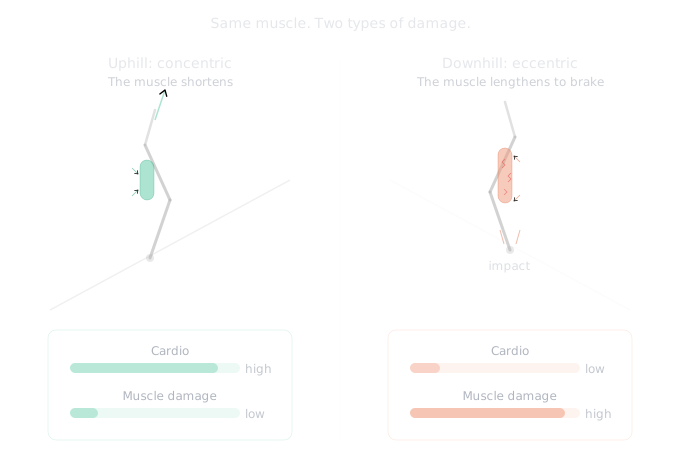
Here's a counterintuitive fact: when you compare muscle fatigue at the end of equally long races, you don't see a major difference between races with elevation and flat races. On a 24h track race, DOMS is as bad as after a UTMB. The reason is simple: at every running step, there's already an eccentric phase (when your foot lands and absorbs the impact). Over 20 hours of running, those thousands of small eccentric phases accumulate damage, with or without descents.
So why specifically talk about descents? Because descents concentrate the strain into a short timeframe, and because that's where you have the biggest progression lever. You can't remove eccentric contraction from running, but you can radically change how you descend.
The two levers for descending well
Guillaume Millet identifies two main aspects. The first is physical, the second is technical. The second matters more than the first.
1. Muscular strength and eccentric resistance
To descend well, you need a minimum of muscle mass and the capacity to absorb repeated eccentric contractions. It's not about having big quads (many lean trail runners descend brilliantly), but about having muscles that can resist damage.
Good news: eccentric work is the best way to build muscle mass. If you're lean to start with and you switch to trail running, you'll naturally gain a bit of muscle in the legs because repeated descents trigger adaptations (more damage, more repair, relative hypertrophy). Not bodybuilder territory, but enough to gain the durability you need.
How to train this specifically: repeated descent sessions, ideally at a ski resort (chairlift up, run down, repeat). Less sexy than an interval session, but it's what makes you resistant to muscle damage. The ideal way to densify this work when preparing an ultra: build it into a shock weekend, two consecutive days of long runs that reproduce the cumulative fatigue of a real race.
2. Technique: the lever that makes the difference
That's where the real gain is, and that's where most runners leave minutes on the trail.
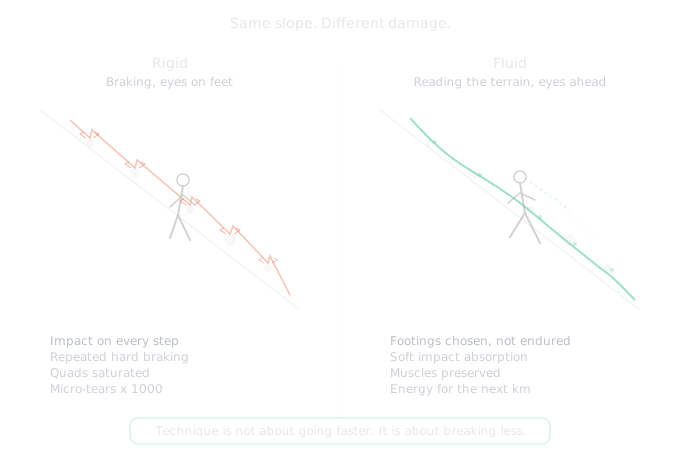
Downhill technique isn't "running fast on descents". It's reading the terrain, choosing footings, staying fluid, never locking up. The best descenders all share one trait: they don't look at their feet, they look far ahead. Their brain processes the trajectory several metres in advance, and their feet do what they need to do without explicit thought.
The profiles that descend well aren't always the ones you'd expect. Former mountain bikers often descend very well, used to reading the terrain at high speed. Skiers (ski mountaineering, cross-country, downhill) too: skiing forces you to anticipate and dose engagement. Runners who grew up in the mountains, running on trails since childhood, start with a huge advantage. Kilian Jornet is a textbook case: born in the Pyrenees, running on scree slopes from the moment he could walk.
For those who didn't have that luck, the good news is that it can be trained. Not just by running. Mountain biking, skiing in winter, descending technical trails without chasing performance at the start: all of it progressively builds the capacity to read the terrain. It's exactly the same logic of stimulus variation found in ultra-trailers who run the marathon to work their flat-ground stride.
And here's what's crucial to understand: technique isn't just about going faster. It's about minimising muscle damage. A fluid runner, who doesn't lock up, who chooses footings well, absorbs fewer impacts, brakes less harshly, wears their muscles less. In an ultra, that's the difference between reaching km 60 with functional legs or with concrete blocks.
Run or walk on a slope? The 15-degree rule
A question that comes up constantly with runners moving into trail: at what point should you walk rather than run?
A study by Roger Kram (US biomechanist) gave a numerical answer. On flat ground, the speed at which walking becomes more economical than running sits around 7 to 7.5 km/h (4.4 to 4.7 mph). Above, running is more efficient. Below, walking is. That's why you naturally switch from one to the other: your body optimises spontaneously.
When the slope increases, that threshold drops. At 15 degrees of slope (about 22 to 25%), the switch happens at only 5 km/h (about 3.1 mph). In other words: above 22% slope, you can walk as fast as you can run, sometimes faster if you're not trained to run on that kind of terrain.
Small caveat: on very steep slopes, you're often less economical running than walking because you're not used to running on those slopes. The body hasn't optimised its operation in those conditions. Don't force yourself to run a 25% slope "on principle" if you can climb faster walking.
One more thing: if you have poles, it's probably worth switching to walking a bit earlier, because walking with poles becomes very efficient on those slopes.
And on flat ground? The run/walk threshold also depends on your target speed. To convert your pace to km/h or mph, use the pace calculator. To project a race time over a given distance, the race time predictor.
Trekking poles: when and why to use them
Poles still divide the community. Some runners refuse to take them (they consider it cheating, or they don't like "carrying gear"). Others use them systematically. The science has settled it: in an ultra, leaving without poles is a strategic mistake.
Main benefit: offload the legs. Every push on a pole is that much less load for your quadriceps. Over 170 km of UTMB, every percentage of muscular load you can transfer to your arms is a percentage of muscle damage avoided. Your arms will tire too. So what? It's not your arms that will limit your performance. It's your legs.
The math is counterintuitive but ironclad. Even if poles cost you a bit more metabolic energy (you mobilise more muscles), you gain so much on leg preservation that overall endurance improves. It's a trade-off: sacrifice a bit of running economy to gain on resistance to muscle damage. Same logic as what pushes ultra-trailers to work on low-intensity easy aerobic running: preserve, and you extend.
On descents, top runners use poles sparingly, they can even get in the way of fluidity on technical sections. But going up, even on light slopes, poles are a major lever. And on very steep climbs, studies have shown that on top of relieving the legs, they improve energy cost. Double benefit.
Kilian Jornet attempted UTMB without poles at one point, betting on his exceptional muscular durability. He's gone back to poles since. If even he judges that they're worth it, the question is settled for those of us who aren't in the global top 5.
The only real argument against poles was their weight. But modern foldable, ultra-light models have made that concern disappear. Slipping them into your pack when you don't need them, pulling them out on the fly: all of that takes 10 seconds.
One crucial detail: a pole is useless if your upper body fails before your legs. That's why core training and arm-shoulder strength is part of trail preparation just as much as descents are. Solid arms, stable trunk, useful poles: the three go together.
The hidden gain for women runners
Guillaume Millet makes an interesting observation: on average, women runners hold back more on descents than men. Not all of them. Some women descend light-years ahead of most men. But the average tendency is there.
That's not a judgment of capacity, it's an observation. And above all, it's an opportunity. Women runners who work on engagement on descents (technique, line reading, trust in their footings) potentially gain even more time than men do from the same work. Because they start further back, their progression margin is larger.
If you're a woman runner and you feel you brake on descents, it's a huge lever. Working descents progressively, on varied terrain, accepting being a little scared at first: it's probably the highest-yield lever in your entire trail preparation.
What it changes for your training
A few concrete principles to take away.
Descents are not "dead time" where you recover. They're race moments that deserve specific training, as much as if not more than climbs. And if you come back from a big descent session with broken legs, it's the moment to revisit how to reload without breaking what you're rebuilding.
To progress, variety pays: mountain biking, skiing, run descents (at a resort if you live in flat country, on real terrain if you have it). The goal isn't to "run faster on descents". It's to become more fluid, learn to read the terrain, stop locking up.
If you're doing an ultra, take poles. Even if you have "good legs". What you transfer to your arms is what you don't break in your legs. And over 15h or 30h of racing, that's what makes the difference between being able to run the final kilometres or walking in pain. Same logic as what governs marathon prep: long races are won on muscular preservation, not on starting-line explosiveness.
Finally, accept that the real lever for descents isn't in your legs. It's in your head, in your eyes, in your ability to look far ahead and let your body do what it knows how to do. It's a trust-building exercise as much as a technical one. And that's also why it takes time to progress. If you feel that lever isn't moving despite the hours spent on descents, an outside eye can sometimes spot what you no longer see.
The mountain isn't won by climbing harder or descending faster. It's won by breaking your legs less. The rest follows on its own.
Start free
Kopilo builds your trail plan factoring in your terrain, your elevation, and your durability level. A copilot that knows the descent is prepared as much as the climb.